
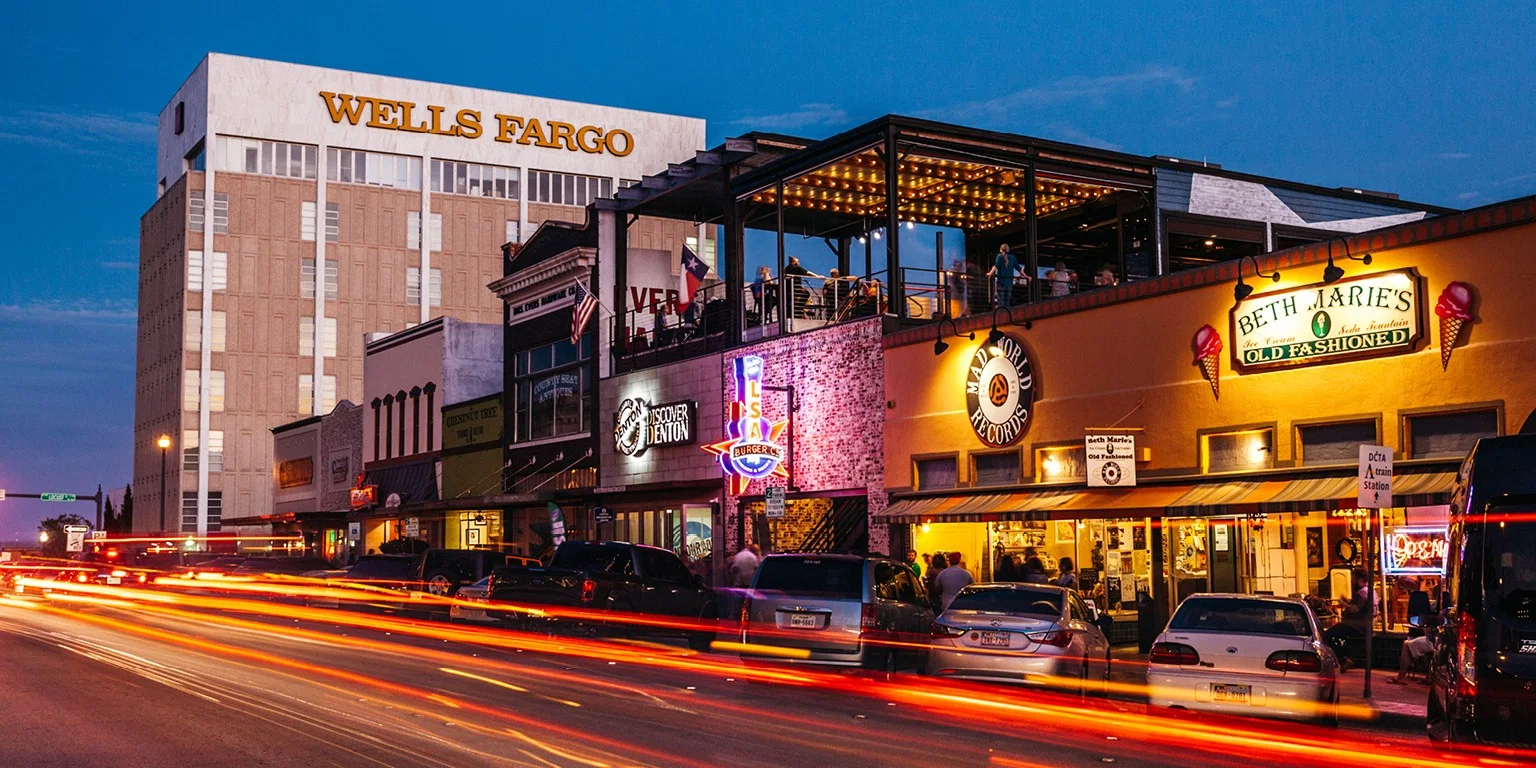
Service Area
Denton, TX
A university market 40 miles north of downtown Dallas, Denton runs its trade shows and campus expos on crews and freight staged out of the Frisco and Dallas core.
Denton sits at the north edge of the metro, defined by the University of North Texas and Texas Woman's University rather than by a convention district of its own. Most of the exhibitions that touch Denton are campus career fairs, regional conferences held in university event space, and community expos rather than large trade-floor programs, so the work here is smaller in scale but still needs the same install discipline as a downtown hall.
Because Denton has no dedicated convention center, every program run out of this market is coordinated from a venue elsewhere in the metro or from university facilities directly. We treat Denton as a satellite market: crews, trucks, and rental inventory stage from Frisco or the Dallas core and drive in on a schedule timed to I-35E traffic and campus load-in windows.
Denton's market position
Denton's economy runs on the two universities, a growing logistics corridor along I-35E, and a historic downtown square that hosts community and vendor events rather than trade shows. The exhibition demand here is real but thin compared to Dallas or Frisco, and it skews toward academic conferences, job fairs, and small regional expos held in campus centers.
The right venues for a Denton program
Denton has no standing convention center, so a program based here typically runs in a university facility, a hotel ballroom, or the Denton County fairgrounds. For anything requiring true trade-show infrastructure, we route the program to the nearest full-service venues: Embassy Suites & Frisco Conference Center and Omni Frisco Hotel at the Star, both roughly 25 minutes south, or Kay Bailey Hutchison Convention Center Dallas for larger citywide events.
Embassy Suites & Frisco Conference Center — nearest full-service hall
Omni Frisco Hotel at the Star — corporate and conference space
Kay Bailey Hutchison Convention Center Dallas — for citywide programs
Freight and loading in a university market
Campus loading docks were built for catering and facilities traffic, not tractor-trailers, so freight into a Denton event usually means smaller box trucks staged at a service entrance with a campus escort. Anything arriving on a full 53-foot trailer gets cross-docked at our Frisco or Dallas staging point first and forwarded in on vehicles the venue can actually accommodate.
Local labor coordination
We pull install and dismantle crews from the same Dallas-Fort Worth labor pool that covers Frisco and Plano, since Denton doesn't support a standing local crew base of its own. Call times build in the extra 30-40 minutes of drive time from the metro core, and we schedule around UNT and TWU academic calendars, which shift traffic and parking availability sharply during move-in weeks.
Drayage and warehousing
Advance freight for a Denton program is warehoused at our Frisco-area facility rather than on site, since neither the university venues nor the fairgrounds offer secure long-term storage. Crates and pallet freight sit in climate-controlled storage until the load-in date, then move up on the day of.
Install and dismantle windows
University venues run on tight academic scheduling, so install windows in Denton are often shorter than a comparable hotel or convention hall booking — sometimes a single overnight turn between classes or events. We build the crew count and timeline around that constraint rather than assuming a full move-in day.
Booth and exhibit build for smaller floors
Denton programs are rarely large-format island builds; most are inline booths, pop-up displays, and modular kits sized for a gymnasium, ballroom, or student union space. We fabricate to those dimensions rather than defaulting to convention-hall scale, which keeps freight and labor costs proportional to the actual event.
AV and rigging in campus and hotel spaces
Rigging points in a university auditorium or hotel ballroom are far more limited than a convention hall's steel grid, so AV plans for Denton lean on ground-supported truss, portable stage decks, and house sound systems where available rather than full overhead rigging.
Ground-supported truss over fly rigging
House sound and lighting integration where available
Portable stage and screen packages
Show-site supervision
Because Denton events run in venues without a dedicated show office, our on-site supervisor also functions as the point of contact for campus facilities or hotel staff, coordinating badge access, parking passes, and after-hours building access that a purpose-built convention center would otherwise handle.
Logistics and shipping in and out
Outbound freight from a Denton show routes back through the Frisco warehouse for consolidation before continuing to the next market, since shipping carriers rarely schedule direct pickups from university loading areas. This adds a half-day to the return timeline that we build into every quote.
Crew lodging
Crews working a Denton program lodge in Frisco or along the Denton square rather than downtown Dallas, keeping drive time to load-in under 30 minutes. For multi-day university conferences we book block rates near campus so crews aren't fighting football-weekend or graduation-weekend pricing spikes.
Parking and dock access
Parking at UNT and TWU is permit-controlled and tightest during the fall and spring semesters, so we secure loading permits and temporary parking passes through the university's events office well ahead of move-in rather than assuming street access will be open.
Timing and lead time
Because Denton bookings often depend on university room availability rather than a venue's own sales calendar, lead times can be unpredictable — sometimes locked in months out, sometimes confirmed only a few weeks ahead once a department finalizes its event. We keep a standing crew and freight plan ready to compress the timeline when needed.
Budget realities for a Denton program
Venue rental in Denton is often lower than a downtown Dallas hall, but the savings get partly offset by the extra freight leg from Frisco and the smaller-scale labor call minimums that still apply regardless of floor size. We quote Denton programs on their real logistics footprint, not on a downtown day rate.
What makes Denton specific
Denton is a college town first — the exhibition calendar follows the academic year, not a convention bureau's booking cycle, and event weekends often collide with football Saturdays or graduation traffic that changes hotel pricing and road access across the whole city.
Event types that fit this market
Career fairs, academic and professional conferences hosted by the universities, county and regional trade expos, and community vendor markets make up the bulk of Denton work. Large-format consumer or industry trade shows generally get routed to Frisco or Dallas instead.
Routing to the nearby markets
For anything beyond a campus-scale event, we route the program south to Frisco's hotel and conference venues, or further to Kay Bailey Hutchison Convention Center Dallas for citywide scale, using the same crew and freight plan we run for Denton's I-35E corridor.
How we run it here
A Denton program gets treated as what it is — a satellite market served by Frisco- and Dallas-based crews and freight rather than a stand-alone convention destination. We build the timeline around university scheduling constraints, keep freight staged nearby rather than on site, and scale the booth build to the room it's actually going into.
the city trade show market
Trade shows in the city move fast. Major venues book out months in advance, freight windows run tight, and the exhibitors who win their weeks are the ones who arrive with a plan already in hand.
Trade show weeks in the city compress decisions. Dock windows are finite, rigging slots fill fast, and the labor calendar around a citywide conference runs hot. Exhibitors who treat planning as optional lose time they don't get back.
the city offers more than 440,000 square feet of meeting space and is near two major airports, which sets the practical ceiling for a booth program working the market.
Omni Dallas Hotel as adjacent to the Dallas Convention Center, reinforcing the downtown hotel-plus-convention-center workflow — a useful reference point when sizing a project.
Where the city shows actually happen
The building matters more than almost anything else in a trade show plan. A few the city venues carry most of the calendar.
A venue walk — either in person or via the published floor plan — is the step that reveals constraints no spec sheet shows. Column spacing, real ceiling height at the grid point, and dock access shape what's actually buildable.
Omni PGA Frisco Resort is one of the anchors. The resort has 500 guest rooms and suites plus 10 four-bedroom ranch houses.
The property has more than 127,000 square feet of indoor and outdoor meeting and event space.
Globe Life Field: it is located in the Arlington Entertainment District adjacent to AT&T Stadium.
Toyota Music Factory. It includes The Pavilion at Toyota Music Factory, a 8,000-capacity indoor/outdoor concert venue.
Who handles what during the the city install window
Most of what goes wrong on a the city install traces back to assumptions about labor. We stay inside the rules for the specific show, which prevents it.
Practically, that means pulling the current exhibitor manual for every show and confirming a handful of items in writing: which tasks the venue's house crews cover, which tasks the show's general contractor covers, and what an exhibitor or their appointed contractor can handle without escalation.
Scope in Denton, TX
Projects in Denton, TX typically include design work, fabrication or rental sourcing, graphics production, show-service paperwork, freight, install, show-hours coverage, and strike.
What shows up in most budgets: structure, graphics, AV, show-service orders through the venue, labor, freight, supervision days, and closeout. Individual projects layer or remove items based on scope.
A well-run project has few surprises on install day because the handoffs upstream were tight. A bad one has many, because they weren't.
Multi-show programs add asset management: storage, refurbishment, graphic swaps, and scheduled re-kitting so the booth rolls cleanly from the city to the next city on the calendar.
Out of scope by default are show organizer fees, booth lease costs paid directly to the show, staff travel and per diems, and any custom software or data-capture tooling the client runs on its own stack. Those stay on the client side and plug into the project through coordination, not rebilling.
From first call to strike
Every engagement begins the same way. The venue, the show dates, the footprint, and the target outcome go on the table first. From those four inputs, a real plan can be built.
After the brief, the work turns to the building itself. Dock windows, utility orders, rigging approvals, and labor calls are all confirmed in writing before anything goes to fabrication.
Production covers fabrication, graphics, AV spec, rentals, and crew chief assignment. It is the longest phase of most projects and the one where timelines are either protected or lost.
Install days are owned by a single show floor lead. That person carries the plan, works the punch list in real time, and reports up once a day with real status.
Throughout show hours, the show floor lead stays present. Tech breaks, sponsor changes, venue requests — all handled without pulling the client team off the floor.
Strike and closeout happen the same day. Storage labels, outbound manifests, vendor performance notes, and a written debrief go out within 24 hours of doors closing.
Budget and timeline
Every project has the same cost drivers. The number depends on scope, and scope depends on a handful of specific variables.
Six variables drive the cost: custom versus rental, booth footprint and complexity, venue-specific labor and rigging fees, graphics scope and substrate, freight distance and timing, and the number of on-site supervision days.
Lead time drives everything. Custom: 16 to 20 weeks. Rental: 8 to 12. Under 4 weeks is possible but narrows choices and raises cost.
How project performance gets measured
The measure of a good engagement is simple: on-time install, no venue callouts, clean show hours, and a closeout that makes the next event easier to book.
Most programs in the city are evaluated on lead-capture volume, meetings booked on the floor, and qualified-pipeline attribution after the show. The booth is a means to those numbers — it is not the number itself.
A week after the show, the booth's actual floor performance is already clearer than any pre-show projection. We document those observations alongside the technical closeout so the next cycle inherits real signal, not nostalgia.
The advantage of a local the city team
Trade Show Services keeps the work local. Design, build, and install share the same team and the same playbook, which is how quality survives across a show week.
Working with a the city-based shop matters most when something goes wrong on-site. Solutions live within driving distance instead of on another coast.
Consistency across show dates is the other reason to hire local. The same crew that built the booth runs the install, knows the pack-out, and catches the small things — a missing hardware pack, a graphic edge that needs reseating, a storage crate routed to the wrong bay — without needing the client team to intervene.
Denton, TX — what the area looks like for events
Denton, TX is one of the the city area submarkets we cover for trade show work.
Trade show work in Denton, TX shares most of its structure with larger the city projects. Where it diverges is in the nearby venue mix, freight routing, and local hotel block availability.
Denton, TX planning questions
Q: Do you work at Omni PGA Frisco Resort?
Yes. the resort has 500 guest rooms and suites plus 10 four-bedroom ranch houses. Projects at that building are planned against its specific floor rules.
Q: How much lead time is ideal?
Custom builds run best with 16 to 20 weeks of lead time. Rentals take 8 to 12 weeks. Work inside 4 weeks is possible but raises costs and narrows the options.
Q: What information kicks off a project?
The show, the venue, the booth number, the dates, and a target budget range. From those, an initial scope and a realistic cost come back within a few days.
Q: Who runs the booth on-site?
One named show-site lead runs the install, the show hours, and the strike. That person carries the floor plan and the punch list from crates to doors and reports up once a day.
Q: Can the booth travel to the next city on our calendar?
Yes — builds are designed for modular reuse unless single-use scenic is specifically required. Same structure, swappable graphics, standard crates. the city programs that roll to another city on the same calendar get handled end to end.
Q: What happens if something breaks during show hours?
The show floor lead handles it. Minor repairs happen in place; anything larger gets sourced from the local fabricators or rerouted through the venue's service desk.